 A new report published last Friday in the peer-reviewed journal Environmental Sciences Europe is raising significant concern that weeds are evolving to become resistant to GMO crop technology, causing a significant increase in the use of toxic pesticides. Super weeds are cropping up in a similar fashion to the superbugs that have plagued our hospitals. Read more here.
GMO Crops Increase Pesticide Use
October 5, 2012
 1 Comment |
  agriculture, Latest Nutritional Research | Tagged: Dr. Gina Cushman, drgina.com, GMO Foods, HealthBridgeHealing.com, Pesticides |
  Permalink
 Posted by Dr. Gina Nick
BPA Found to Affect Critical Hormones in Pregnant Women and Boys
October 4, 2012 A new study raises concern about the effects of BPA on thyroid hormone levels in pregnant women and in young boys. BPA is found in plastic bottles, the lining of food and beverage cans, dental sealants and even in sales receipts. Originally BPA was found to cause harmful synthetic estrogen-like effects. Now we are learning that it impacts one of the most critical hormone groupings in pregnant women and children. I teach physicians about testing newly pregnant women at a very specific time, for thyroid hormone levels (including TSH, Free T3, Free T4 and TPO Antibodies) because if left untreated, an imbalance in these hormones will lead to recurrent miscarriage, difficulty producing breast milk, and serious developmental challenges in a newborn.
Leave a Comment » | Latest Nutritional Research, Pregnancy, Thyroid Health | Tagged: BPA, Dr. Gina Cushman, Pregnancy, recurrent miscarriage, thyroid health, www.drgina.com, www.healthbridgehealing.com | Permalink
Posted by Dr. Gina Nick
Birth Control for Men
July 24, 2012
Now this makes sense! A male contraceptive procedure that is 100 percent effective and reversible, and takes about 15 minutes to complete. Learn more by clicking here. How many women’s lives would be saved if they no longer had to routinely introduce synthetic hormones into their body? Hormonal contraception in women, unfortunately, is one of the most popular (and convenient) contraceptive strategies available right now. And more unfortunate is the long term damage it can cause to a woman’s health. Conditions including blood clots, stroke, cancer and other chronic diseases with an inflammatory component are well documented potential consequences that women face when taking oral contraceptives.
Let’s hope that better options present themselves and become available here in the US as soon as possible.
In health,
-Dr. Gina
1 Comment | Hormone Replacement Therapy, Women's Health | Tagged: Dr. Gina Cushman, http://www.healthbridge.tv, http://www.healthbridgehealing.com, male contraceptives, oral contraceptive risks, Synthetic Hormone Risks, www.drgina.com | Permalink
Posted by Dr. Gina Nick
CME Presentation Delivered by Dr. Cushman
July 13, 2012
Dr. Gina Cushman, founder of HealthBridge Management and HealthBridge Medical Center, delivered her final lecture in a live pharmacy CME series on thyroid health yesterday July 12th, 2012 at 8 PM EST through PharmCon. The attendee feedback was very positive, with an audience for the series in excess of 3,000 licensed healthcare professionals.
Below are a few of the comments we received from physicians, nurses and pharmacists in attendance…
“Excellent program. I learned a lot.”
“I have thyroid disease and it’s going to help me personally as well as professionally.”
“Very informative, very thorough”
“Best CE from PharmCom to date”
“Great speaker. One of the best CE lessons.”
“Thorough, well organized, excellent thanks so much, learned a lot which i will incorporate in my practice.”
“Very informative, great presentation!!!!”
“This presentation will be very helpful in my practice.”
“Excellent presentation. wonderful slides”
“Very informative”
“Super”
“Fantastic CE”
“Well-organized, knowledgeable speaker. Excellent review of thyroid disease basics, as well as an outstanding discussion of various treatment options.”
“Loved the presentation”
Check back here for news on upcoming live CME presentations offered by HealthBridge and Dr. Gina Cushman.
1 Comment | Pharmaceuticals, Thyroid Health | Tagged: Dr. Gina Cushman, freece.com, healthbridge.tv, HealthBridgeHealing.com, Live CME, Online CME, Pharmacy CME, PharmCon, thyroid health | Permalink
Posted by Dr. Gina Nick
Urgent!!! Protect your Right to a Safe Food Supply and a Healthy Environment. Act TODAY!
June 27, 2012 Below is a news release from Food Democracy Now! that reveals a concerning provision to be considered by the House of Representatives THIS WEEK that takes away the federal court’s ability (and constitutional mandate) to stop the planting and sale of genetically modified crops (GMO crops) during a legal process of appeals when the safety of these foods, our rights as consumers, and the health of the environment are in question. Please take action today to protect your rights to healthy food before corporate profits.
In health,
-Dr. Gina
—
Stop the Monsanto Protection Act!
This week the House of Representatives will consider a provision to House Agricultural Appropriations Bill that will fundamentally undermine the concept of judicial review. Hidden under the guise of a “Farmer Assurance Provision” (Section 733), the provision strips the rights of federal courts to halt the sale and planting of genetically engineered crops during the legal appeals process. In the past, legal advocates have successfully won in court the right to halt the sale and planting of unapproved GMO crops while the approval of those crops is under review by a federal judge. This dangerous new House provision, which were calling the Monsanto Protection Act, would strip judges of their constitutional mandate to protect consumer rights and the environment, while opening up a floodgate of planting of new untested genetically engineered crops, endangering farmers, consumers and the environment.
Once again, Monsanto and the biotech industry are working behind closed doors to undermine your basic rights.
This time they’ve gone too far! Join us in putting a stop to the Monsanto Protection Act!
Leave a Comment » | agriculture, Industry News, News, organic foods | Tagged: Dr. Gina Cushman, Farmer Assurance Provision, genetically modified foods, GMO Foods, HealthBridgeHealing.com, monsanto, www.drgina.com | Permalink
Posted by Dr. Gina Nick
Live CME Webinar Series on Thyroid Health
April 19, 2012
Join PharmCon’s pharmaceutical webinar series on “Innovative Strategies for Optimizing Thyroid Function” on April 23rd at 10:30 AM EST with Dr. Gina Cushman, NMD, PhD, founder of HealthBridge Management LLC and HealthBridge Medical Center in Newport Beach, CA.
Dr. Cushman will be discussing the benefits and appropriate use of the various thyroid medications available to healthcare practitioners, and a new approach to the diagnosis and treatment of thyroid-related imbalance.
AMA and ACPE approved for 1.25 live pharmaceutical continuing medical education credits. Cost is free to members (nominal $50 annual fee for unlimited access to live CMEs) and $30 to non-members.
Register Now
Leave a Comment » | Hormone Replacement Therapy, Industry News, Thyroid Health, Women's Health | Tagged: Dr. Gina Cushman, Natural Thyroid Treatment, Nature-throid, PharmCon, RLC Labs, Thyroid Continuing Medical Education, Thyroid Treatment, www.freece.com, www.healthbridge.tv, www.healthbridgehealing.com | Permalink
Posted by Dr. Gina Nick
NEWS Release
March 12, 2012 (Newport Beach, CA) – Due to overwhelming demand and positive feedback from the global healthcare profession, Gina Cushman, NMD, PhD has been invited by PharmCon to deliver a fourth presentation on thyroid health on Monday, April 23rd at 10:30 AM EST. PharmCon is the leading provider of live online continuing education to the healthcare profession through its principal operating division – FreeCE, with over 250,000 registered users. PharmCon offers healthcare professionals the flexibility and convenience of completing an education program from virtually anywhere.
Feedback from physicians and pharmacists attending Dr. Cushman’s January 2012 lecture included, “Best program I have EVER attended!”; “What a blessing to have well informed practitioners!!! We need help informing the MD population!”; “Excellent presentation”; “Very effective explanation and treatments”; and “Awesome presentation!!! One of the best!!”
The presentation offering 1.25 hours of LIVE pharmaceutical CE credit hours runs from 10:30 AM to 11:45 AM Eastern on http://www.FreeCe.com. Cost to participate is free to PharmCon members or $30 per person.
1 Comment | Industry News, Latest Nutritional Research, News, Thyroid Health | Tagged: Dr. Gina Cushman, FreeCe.com. Thyroid Health, Natural Thyroid Treatment, NatureThroid, PharmCon, www.healthbridge.tv | Permalink
Posted by Dr. Gina Nick
A Pharmacist’s Perspective on Drug-Nutrient Interactions and the Value of Nutritional Medicine
January 30, 2012
An interesting commentary below…by a registered pharmacist, released through the Orthomolecular News Service, about the importance of including nutrient deficiencies in the mix, when considering pharmaceutical medications for the prevention or treatment of disease.
In health,
-Dr. G
___
Confessions of a Frustrated Pharmacist
by Stuart Lindsey, PharmD.
I’m a registered pharmacist. I am having a difficult time with my job. I sell people drugs that are supposed to correct their various health complaints. Some medicines work like they’re supposed to, but many don’t. Some categories of drugs work better than others. My concern is that the outcomes of treatment I observe are so unpredictable that I would often call the entire treatment a failure in too many situations.
How It Started
In 1993, I graduated with a BS in Pharmaceutical Sciences from University of New Mexico. I became pharmacy manager for a small independent neighborhood drug store. Starting in the year 2000, nutrition became an integral part of our business. The anecdotal feedback from the customers who started vitamin regimens was phenomenal. That same year, my PharmD clinical rotations began with my propensity for nutritional alternatives firmly in place in my mind. On the second day of my adult medicine rotation, my preceptor at a nearby hospital informed me that he had every intention of beating this vitamin stuff out of me. I informed him that probably wouldn’t happen. Three weeks later I was terminated from my rotations. The preceptor told my supervisor at UNM that there were acute intellectual differences that couldn’t be accommodated in their program. What had I done? I was pressuring my preceptor to read an article written by an MD at a hospital in Washington state that showed if a person comes into the emergency room with a yet to be diagnosed problem and is given a 3,000-4,000 mg bolus of vitamin C, that person’s chance of dying over the next ten days in ICU dropped by 57%! [1]
One would think that someone who is an active part of the emergency room staff might find that an interesting statistic. His solution to my attempting to force him to read that article was having me removed from the program.
Pecking Order
The traditional role of the pharmacist in mainstream medicine is subordinate to the doctor. The doctor is responsible for most of the information that is received from and given to the patient. The pharmacist’s responsibility is to reinforce the doctor’s directions. The doctor and the pharmacist both want to have a positive treatment outcome, but there is a legally defined ‘standard of care’ looking over their shoulder.
The training that I received to become a PharmD motivated me to become more interested in these treatment outcomes. After refilling a patient’s prescriptions a few times, it becomes obvious that the expected positive outcomes often simply don’t happen. It’s easy to take the low road and blame it on “poor compliance by the patient.” I’m sure this can explain some treatment failure outcomes, but not all. Many (indeed most) drugs such as blood pressure regulators can require several adjustments of dose or combination with alternative medicines before a positive outcome is obtained.
Wrong Drug; Wrong Disease
One drug misadventure is turning drugs that were originally designed for a rare (0.3% of the population) condition called Zollinger-Ellison syndrome into big pharma’s treatment for occasional indigestion. These drugs are called proton-pump inhibitors (PPI). [2] After prolonged exposure to PPIs, the body’s true issues of achlorhydria start to surface. [3]
These drugs are likely to cause magnesium deficiency, among other problems. Even the FDA thinks their long-term use is unwise. [4]
The original instructions for these drugs were for a maximum use of six weeks . . . until somebody in marketing figured out people could be on the drugs for years. Drug usage gets even more complicated when you understand excessive use of antibiotics could be the cause of the initial indigestion complaints. What you get from inserting proton pump inhibitors into this situation is a gastrointestinal nightmare. A better course of medicine in this type of case might well be a bottle of probiotic supplements (or yogurt) and a few quarts of aloe-vera juice.
Many doctors are recognizing there are problems with overusing PPI’s, but many still don’t get it. An example of this is my school in NM had a lot of students going onto a nearby-impoverished area for rotations. They have blue laws in this area with no alcohol sales on Sunday. The students saw the pattern of the patients going into the clinics on Monday after abusing solvents, even gasoline vapors, and having the doctors put them on omeprazole (eg. Prilosec), long term, because their stomachs are upset. This is medicine in the real world.
Reliability or Bias?
Mainstream medicine and pharmacy instill into their practitioners from the beginning to be careful about where you get your information. Medical journals boast of their peer review process. When you discuss with other health professionals, invariably they will ask from which medical journal did you get your information. I actually took an elective course in pharmacy on how to evaluate a particular article for its truthfulness. The class was structured on a backbone of caution about making sure, as one read an article, that we understand that real truthfulness only comes from a few approved sources.
I was never comfortable with this concept. Once you realized that many of these “truthfulness bastions” actually have a hidden agenda, the whole premise of this course became suspect. One of my preceptors for my doctoral program insisted that I become familiar with a particular medical journal. If I did, she said, I would be on my way to understanding the “big picture.” When I expressed being a little skeptical of this journal, the teacher told me I could trust it as the journal was non-profit, and there were no editorial strings attached.
Weirdly enough, what had started our exchange over credibility was a warm can of a diet soft drink on the teacher’s desk. She drank the stuff all day. I was kidding around with her, and asked her if she had seen some controversial articles about the dangers of consuming quantities of aspartame. She scoffed at my conspiracy-theory laden point of view and I thought the subject was closed. The beginning of the next day, the teacher gave me an assignment: to hustle over to the medical library and make sure I read a paper she assured me would set me straight about my aspartame suspicions, while simultaneously demonstrating the value of getting my information from a nonprofit medical journal. It turned out that the article she wanted me to read, in the “nonprofit medical journal,” was funded in its entirety by the Drug Manufacturers Association.
Flashy Pharma Ads
As I read the literature, I discovered that there is very decided barrier between two blocks of information: substances that can be patented vs. those substances that can’t be. The can-be-patented group gets a professional discussion in eye-pleasing, four-color-print, art-like magazines. This attention to aesthetics tricks some people into interpreting, from the flashy presentation method, that the information is intrinsically truthful.
The world’s drug manufacturers do an incredibly good job using all kinds of media penetration to get the word out about their products. The drug industry’s audience used to be confined to readers of medical journals and trade publications. Then, in 1997, direct-to-consumer marketing was made legal. [5]
Personally, I don’t think this kind of presentation should be allowed. I have doctor friends that say they frequently have patients that self-diagnose from TV commercials and demand the doctor write them a prescription for the advertised product. The patients then threaten the doctor, if s/he refuses their request, that they will change doctors to get the medication. One of my doctor friends says he feels like a trained seal.
Negative Reporting on Vitamins
A vitamin article usually doesn’t get the same glossy presentation. Frequently, questionable vitamin research will be published and get blown out of proportion. A prime example of this was the clamor in the press in 2008 that vitamin E somehow caused lung cancer. [6]
I studied this 2008 experiment [7] and found glaring errors in its execution. These errors were so obvious that the experiment shouldn’t have gotten any attention, yet this article ended up virtually everywhere. Anti-vitamin spin requires this kind of research to be widely disseminated to show how “ineffectual” and even “dangerous” vitamins are. I tracked down one of the article’s original authors and questioned him about the failure to define what kind of vitamin E had been studied. A simple literature hunt shows considerable difference between natural and synthetic vitamin E. This is an important distinction because most of the negative articles and subsequent treatment failures have used the synthetic form for the experiment, often because it is cheap. Natural vitamin E with mixed tocopherols and tocotrienols costs two or three times more than the synthetic form.
Before I even got the question out of my mouth, the researcher started up, “I know, I know what you’re going to say.” He ended up admitting that they hadn’t even considered the vitamin E type when they did the experiment. This failure to define the vitamin E type made it impossible to draw a meaningful conclusion. I asked the researcher if he realized how much damage this highly quoted article had done to vitamin credibility. If there has been anything like a retraction, I have yet to see it.
Illness is Not Caused by Drug Deficiency
If you’ve made it this far in reading this article you have discerned that I’m sympathetic to vitamin arguments. I think most diseases are some form of malnutrition. Taking the position that nutrition is the foundation to disease doesn’t make medicine any simpler. You still have to figure out who has what and why. There are many disease states that are difficult to pin down using the “pharmaceutical solution to disease.” A drug solution is a nice idea, in theory. It makes the assumption that the cause of a disease is so well understood that a man-made chemical commonly called ‘medicine’ is administered, very efficiently solving the health problem. The reality though, is medicine doesn’t understand most health problems very well. A person with a heart rhythm disturbance is not low on digoxin. A child who is diagnosed with ADHD does not act that way because the child is low on Ritalin. By the same logic, a person with type II diabetes doesn’t have a deficit of metformin. The flaw of medicine is the concept of managing (but not curing) a particular disease state. I’m hard pressed to name any disease state that mainstream medicine is in control of.
Voltaire allegedly said, “Doctors are men who pour drugs of which they know little, to cure diseases of which they know less, into human beings of whom they know nothing.” Maybe he overstated the problem. Maybe he didn’t.
References:
1. Free full text paper at: http://www.ncbi.nlm.nih.gov/pmc/articles/PMC1422648/pdf/20021200s00014p814.pdf
Also: http://www.ncbi.nlm.nih.gov/pmc/articles/PMC1422648/?tool=pubmed
2. http://www.ncbi.nlm.nih.gov/pubmed/2777040 and http://www.ncbi.nlm.nih.gov/pubmed/1697548
3. http://www.ncbi.nlm.nih.gov/pubmed/21509344 and http://www.ncbi.nlm.nih.gov/pubmed/21731913
4. http://www.fda.gov/Safety/MedWatch/SafetyInformation/
SafetyAlertsforHumanMedicalProducts/ucm245275.htm
5. http://www.nejm.org/doi/full/10.1056/NEJMsa070502#t=articleResults
6. Media example:
http://seniorjournal.com/NEWS/Nutrition-Vitamins/2008/8-02-29-VitaminEMay.htm .
OMNS’ discussion at: http://orthomolecular.org/resources/omns/v04n18.shtml
7. Original article at:
http://www.ncbi.nlm.nih.gov/pmc/articles/PMC2258445/?tool=pubmed or http://www.ncbi.nlm.nih.gov/pmc/articles/PMC2258445/pdf/AJRCCM1775524.pdf
Nutritional Medicine is Orthomolecular Medicine
Orthomolecular medicine uses safe, effective nutritional therapy to fight illness. For more information: http://www.orthomolecular.org
Find a Doctor
To locate an orthomolecular physician near you: http://orthomolecular.org/resources/omns/v06n09.shtml
The peer-reviewed Orthomolecular Medicine News Service is a non-profit and non-commercial informational resource.
Editorial Review Board:
Ian Brighthope, M.D. (Australia)
Ralph K. Campbell, M.D. (USA)
Carolyn Dean, M.D., N.D. (Canada)
Damien Downing, M.D. (United Kingdom)
Michael Ellis, M.D. (Australia)
Martin P. Gallagher, M.D., D.C. (USA)
Michael Gonzalez, D.Sc., Ph.D. (Puerto Rico)
William B. Grant, Ph.D. (USA)
Steve Hickey, Ph.D. (United Kingdom)
James A. Jackson, Ph.D. (USA)
Michael Janson, M.D. (USA)
Robert E. Jenkins, D.C. (USA)
Bo H. Jonsson, M.D., Ph.D. (Sweden)
Thomas Levy, M.D., J.D. (USA)
Jorge R. Miranda-Massari, Pharm.D. (Puerto Rico)
Karin Munsterhjelm-Ahumada, M.D. (Finland)
Erik Paterson, M.D. (Canada)
W. Todd Penberthy, Ph.D. (USA)
Gert E. Schuitemaker, Ph.D. (Netherlands)
Robert G. Smith, Ph.D. (USA)
Jagan Nathan Vamanan, M.D. (India)
Andrew W. Saul, Ph.D. (USA), Editor and contact person. Email: omns@orthomolecular.org
2 Comments | Diet and Disease, Healthcare Politics, Latest Nutritional Research, Nutritional Supplements and Disease, Orthomolecular Medicine, Pharmaceuticals | Tagged: Dr. Gina Cushman, Drug Nutrient Interactions, HealthBridgeHealing.com, Orthomolecular Medicine | Permalink
Posted by Dr. Gina Nick
New CME Presentation on Thyroid Health this Wednesday Jan 18th at 5PM Pacific!
January 13, 2012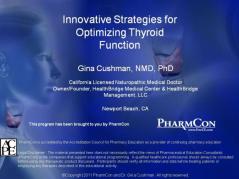
Feedback from physicians and pharmacists in attendance at Dr. Cushman’s lecture last month on this topic was extremely positive (e.g. “This was absolutely the best explanation of thyroid problems I have ever heard; ” “Excellent presentation”)
New research suggests that 13 million Americans, twice the amount we previously thought, may have thyroid disorders and not know it. The thyroid gland is often ignored as the source of symptoms a patient is facing – from weight gain, to brain fog, hair loss, low energy and depression. The “healthy” range for thyroid test results is wide, and not all healthcare practitioners are aware of all components that require testing to screen for thyroid related disorders. This lecture will focus on comprehensive treatment strategies that work to resolve patient symptoms and address the underlying causes for thyroid disorders.
Educational Objectives
* Understand the causes, symptoms and risk factors associated with thyroid-related disorders
* Understand the Hypothalamic/Pituitary/Adrenal axis and the role it plays in thyroid health
* Learn about options for thyroid treatment: T4, T4-T3 mechanisms of action, dosage strategies, benefits and risks
* Learn new strategies for treating thyroid and underlying adrenal issues using an integrative approach to medicine.
Leave a Comment » | Hormone Replacement Therapy, Thyroid Health | Tagged: Dr. Gina Cushman, http://www.healthbridge.tv, http://www.healthbridgehealing.com, Natural Thyroid, NatureThroid, Thyroid and Anxiety, Thyroid and depression, Thyroid Treatment | Permalink
Posted by Dr. Gina Nick
How to Optimize Thyroid Function
December 13, 2011 Dr. Gina Cushman is delivering a second live online Continuing Medical Education presentation this Thursday, December 15th from 9 PM to 10:15 PM ET.
The presentation topic is: “Innovative Strategies for Optimizing Thyroid Function.” Healthcare practitioners (including licensed physicians, pharmacists, nurses and naturopathic physicians) receive LIVE pharmacy credit hours by logging on at www.freece.com and registering for Dr. Cushman’s talk.
Just a few comments from physicians and pharmacists who have attended Dr. Cushman’s presentation:
“Excellent breakdown and explanation of the key differences between thyroid products.”
“Would love to see more programs with Dr. Gina – so interesting – she is GREAT!”
“Excellent speaker and welcomed content!”
The lecture is free to members and only $30 for non-members and you receive 1.25 hours of live continuing medical education credits!
Hope to see you there!
Leave a Comment » | Diet and Disease, Hormone Replacement Therapy, Latest Nutritional Research, Obesity, Pharmaceuticals, Pregnancy, Thyroid Health, Women's Health | Tagged: Continuing Medical Education Credits, Dr. Gina Cushman, healthbridge.tv, HealthBridgeHealing.com, Hypothyroidism, Nature-throid, Pharmacy, thyroid health, www.drgina.com | Permalink
Posted by Dr. Gina Nick

 Dr. Gina's Blog